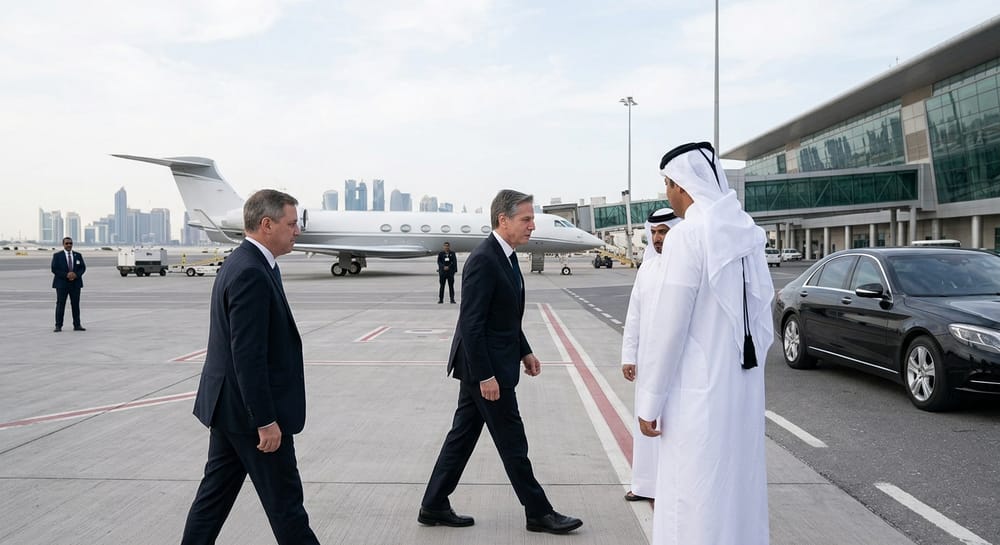
Two U.S. envoys arrived in Doha, Qatar, on Tuesday for meetings with mediators about putting an initial deal linked to the war in Iran into effect, according to the U.S. Department of State and Qatar's Ministry of Foreign Affairs. Qatar said the meetings involve mediation between Washington and Tehran, while Iran's foreign ministry said there would be no direct talks with the United States.
For Chattanooga readers, the immediate local consequence is economic rather than military. Any disruption in the Strait of Hormuz, the narrow waterway used to move a large share of the world's oil and gas, can feed into fuel prices, shipping costs, airline expenses and broader household costs in Tennessee. The U.S. Energy Information Administration and Congressional Research Service both describe the strait as a critical global energy chokepoint.
The talks come as U.S. officials have also warned about increased tension around Hormuz. The Department of Defense said the U.S. Navy had issued a naval alert, and the International Maritime Organization, the United Nations shipping agency, published a notice to mariners on navigational and security risks in the area.
What officials have confirmed about the Doha meetings
The State Department said U.S. envoys had arrived in Qatar for Iran talks. Qatar's foreign ministry said Doha was mediating the discussions. Iran's foreign ministry said Tehran would not hold direct talks with the United States in Qatar, a position also reflected in reporting by IRNA, Iran's state news agency, which described the contacts as indirect.
Qatar is mediating U.S.-Iran talks in Doha, according to the Qatari foreign ministry, while Iran has said there will be no direct talks with U.S. officials.
Based on the official statements released so far, the public facts remain limited. Officials have not publicly detailed the full terms of the initial deal, the names of all participants, or a timetable for any follow-up steps. Where the parties differ is on format, not on the fact that mediation is under way in Doha.
- Who is involved: U.S. envoys, Qatari mediators and Iranian representatives through indirect contacts.
- Where: Doha, the capital of Qatar.
- When: Tuesday, July 1, 2026.
- What is at issue: Implementation of an initial deal related to ending the war in Iran.
- What remains unclear: The deal's full terms, enforcement steps and whether more rounds will follow soon.
Readers who want to understand how this newsroom handles sourcing can review our Source Transparency and Editorial Policy pages.
Why the Strait of Hormuz matters beyond the Gulf
The Strait of Hormuz sits between the Persian Gulf and the Gulf of Oman. It is one of the world's most important shipping lanes for crude oil, petroleum products and liquefied natural gas. That is why official warnings tied to the area can affect prices far beyond the Middle East, including in U.S. cities such as Chattanooga.
The U.S. Energy Information Administration said the waterway remains a critical oil chokepoint during regional conflict. The Congressional Research Service has also warned that conflict or closure threats in Hormuz can disrupt energy and commodity markets. The International Atomic Energy Agency, which monitors nuclear issues, separately issued a statement addressing strikes, nuclear facility risks and threats to close the strait.
What higher Hormuz tensions can mean for local households and businesses
- Drivers: Gasoline and diesel prices can rise if oil shipments face delays or higher risk costs.
- Small businesses: Shipping, freight and inventory costs can increase, especially for firms already managing thin margins.
- Travelers: Airlines can face higher fuel costs, which may filter into fares.
- Investors and retirees: Energy and market volatility can affect savings and pension accounts.
None of those impacts are automatic, and officials have not said the strait is closed. But the Department of State, Department of Defense and IMO have all pointed to elevated risk in the area, which is why these talks are being closely watched.
What residents should watch next
The next concrete sign of progress will be official statements from the U.S. Department of State, Qatar's foreign ministry or Iran's foreign ministry after the Doha meetings. Residents and business owners tracking fuel or supply costs should watch for any updated maritime warnings, naval advisories or announcements about the deal's implementation.
For practical updates, the most reliable channels are official government notices and maritime advisories rather than rumor on social media. If developments begin affecting local travel, fuel prices or business costs in the Chattanooga area, readers can reach our newsroom through Contact Us.
Primary sources: U.S. Department of State, U.S. Department of State, U.S. Department of Defense, U.S. Congressional Research Service, U.S. Energy Information Administration (EIA). Reported by Source Text Link, Qatar Ministry of Foreign Affairs, Iran Ministry of Foreign Affairs, IRNA (Islamic Republic News Agency), International Atomic Energy Agency (IAEA), International Maritime Organization (IMO), Chattanooga Times Free Press.